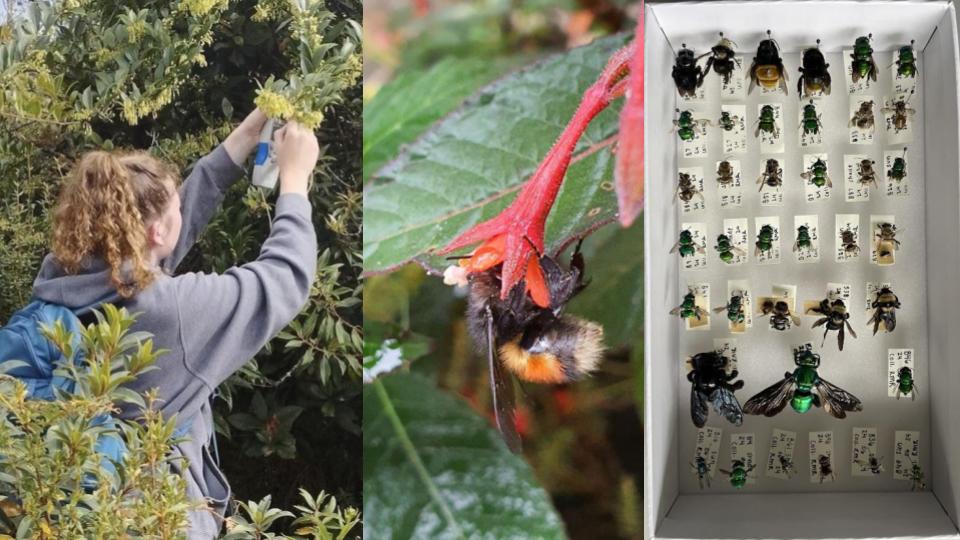
Group 1 investigated the effect of microclimate (sun and shade) on the thermal ecology of pollinators and the community assembly of pollinating bees. Specifically, they tested the following three hypotheses:
H1. Microclimate shapes bee community composition mediated by body size;
H2. Body size is positively associated with the bee’s ability to generate heat; and
H3. Floral morphology shapes microclimatic conditions for foraging bees.
They sampled bees under sun and shade spots across three sites at different altitudes. Their results indicate that (1) elevational gradients (not microclimate) have an effect on the body size of bees; (2) bees’ thoracic temperatures are greater when foraging under the sun; and (3) flower morphology does not impact bees’ body temperatures.
Check out this video to learn more about what they found.
Group 2 collaborated with the drawdown project, an international project that aims to support strategies that will help reverse climate change and eventually reduce global average temperatures. The IRES group working on this project investigated how reducing food waste would release pressure on bees for crop pollination services. They found that, for example, by reducing waste in apple production by 50%, that would reduce the amount of bee visits necessary for apple production by more than 10 billion. More details about their results are in the following video (aquí versión en Español).
Because of our collaboration with the “Manifestations of Climate Change in Extreme Events, Social and Biological Systems”, we are happy to report their results in this blog as well. Their project focused on the spatio-temporal variability of trace gases and solar radiation across elevational gradients in Peru. Their results demostrate evidence of rising temperatures across all sites investigated but that these effects have been more produced at sites in lower elevations. Indeed, the year 2023 was the hottest year in Peru compared to the previous 50 years. These results are among the first ones to be reported for these areas of Peru.
Projects funded by NSF OISE-1952470 and administered by the López-Uribe Lab in the Department of Entomology at Penn State University


No responses yet