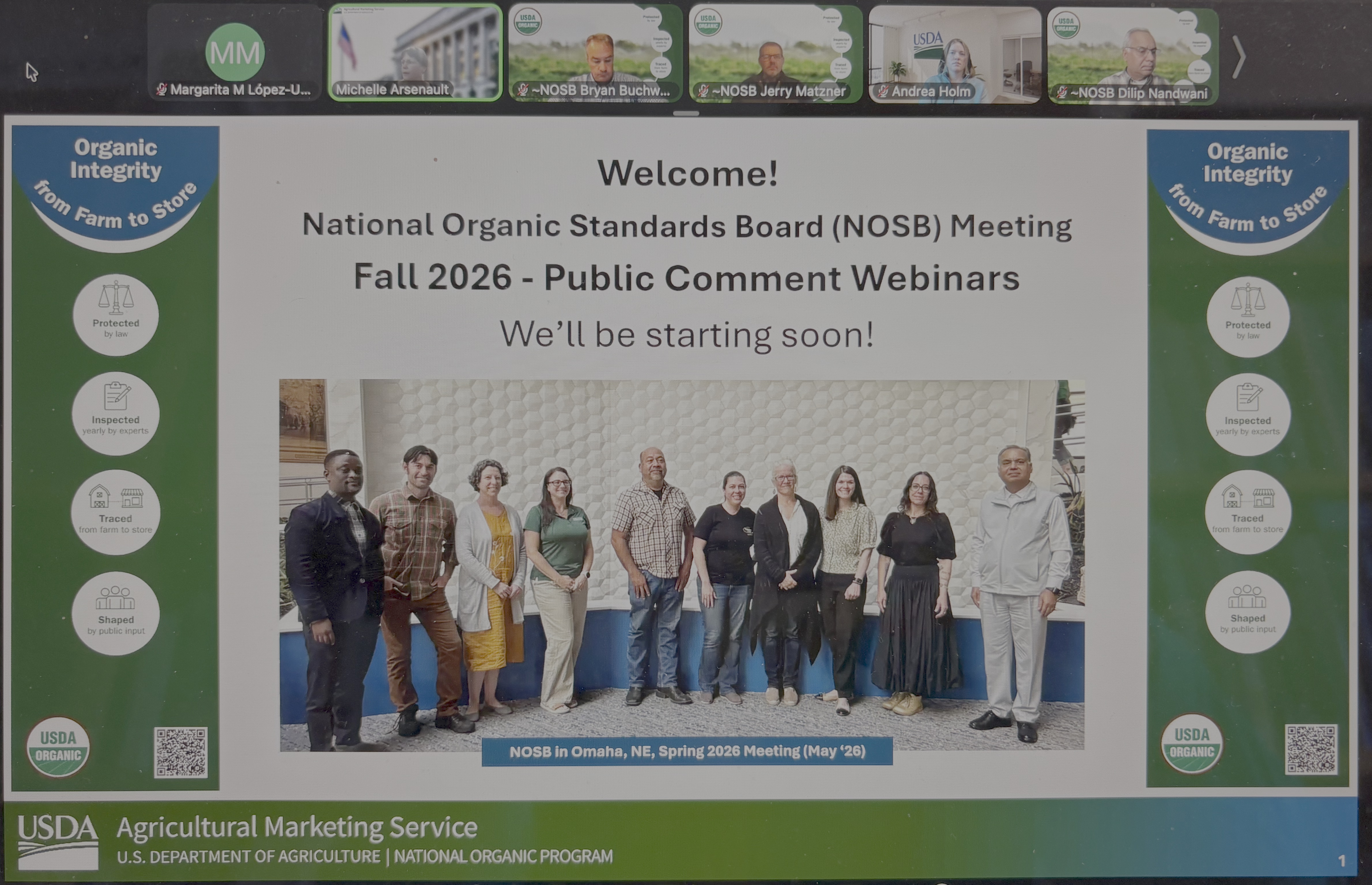
This week, Robyn Underwood and I had the opportunity to comment during the listening session of the National Organic Standards Board (NOSB). After working on applied research on organic apiculture for 10 years, this was a very important moment. Our primary motivation for the research that we do on organic apiculture is to create opportunities for beekeepers in the US to access this market. There are several reasons why we strongly believe that organic apiculture should be larger in the US: organic beekeeping management is excellent for honey bee health, reduces reliance on synthetic miticides, and is profitable for beekeepers. However, almost 100% of the organic honey consumed in the US is imported because even if beekeepers manage their colonies following organic standards, obtaining the USDA organic certification is difficult. Why is that?
Even though there are no formal standards for organic apiculture in the US, the current recommendations suggest that beekeepers need to provide honey bees with pesticide-free forage of 1.8 miles (3 km) around the colonies and an additional buffer zone of 2 miles (3.2 km) where pesticides are not used on plants that honey bees can use. For beekeepers, this means they need to place their colonies in low-input areas of 32,000 acres. The average size of organic farms in the US is around 350 acres. Why do honey bees need such large areas to forage? Where do these numbers come from? Karl von Frisch, who discovered the waggle dance and received the Nobel Prize for it in 1973, wanted to know how far honey bees can fly in search of food. So, in early spring, when few flowers were in bloom, he trained honey bees to follow artificial feeders and noticed they would fly as far as 13.5 km. These experiments revealed something biologically spectacular about honey bees: they can fly VERY far in search of food. But is this what the honey bees do on a regular basis
Honey bees are optimal foragers. This means they assess the energetic gains they receive from the food they forage and how far they need to go to find these resources. If the quality of the resources is low or if there is nothing else to eat, honey bees will fly far to forage. But most of the time, they prefer to forage on nearby floral resources that provide good nutrition. Indeed, many recent studies by my friend and colleague Maggie Couvillon have demonstrated that, on average, honey bees forage within a 158-acre (800 m or 0.5 miles) area around the colony. These are areas 200 times smaller than those suggested by the current NOSB recommendations.
However, like with everything in biology, honey bee foraging is context-dependent and dynamic. Honey bees can forage farther away from the colony during times of low floral availability, for example, during the fall. So, what did we recommend to NOSB and organic certifiers during the call this week? We know that to produce clean honey products, honey bees do not need 32,000 acres of clean forage. We demonstrated this in a recent study led by Ben DeMoras (see here). And while we cannot yet provide NOSB with the specific recommendations for foraging areas, this is the question we will tackle during our next project.
Having this opportunity to speak to NOSB this week felt like one of the most important things I’ve done in my scientific career. Members of the NOSB board listened to my 3-minute speech and asked several questions afterward. They asked for advice on recommendations for organic certifiers, and several of them thanked us for the important research that we are doing. Anyone can sign up to speak to NOSB during these listening sessions. What felt unique about speaking to NOSB this week was being able to share information based on our research and having members of the National Organic Board listen and ask questions that may change policy to benefit US beekeepers and consumers. This is the real impact of science!
Post by Margarita López-Uribe
October, 2026
Leave a Reply