Category: Uncategorized

  • Pollinator Webinar Series – Summer 2020

    Pollinator Webinar Series – Summer 2020

    cover_small

    Wednesdays @3PM (EST) – 1h 15 min via zoom

    Join us for the Pollinator Webinar Series organized moderated by Tom Butzler and Dr. Margarita Lopez-Uribe from Penn State Extension. These eight webinars will cover a whole range of topics from beekeeping management to wild bee biodiversity and how to create habitat for pollinators. Webinars will take place on consecutive Wednesdays, starting on June 3rd at 3 PM (EST), 2 PM (CST), 1 PM (MST), and 12:00 PM (PST). Even though registration is required, there is no cost for attending these webinars. Find details about the webinar topics and how to register below.


    June 3rd – Pollinator Health Challenges: A bee’s perspective (Margarita López-Uribe) – Several bee populations are in decline around the globe. Like for many other animals and plants, the drivers of bee declines include habitat destruction, exposure to pesticides, increased pathogen burden, and climate change. This seminar will explain in detail how these stressors impact bee health throughout each step of the bee’s life cycle. [Watch Now] [Read Summary]


    June 10th – The three most important steps to ensuring honey bee colony survival over the long term (Robyn Underwood) – Honey bee colony management is essential for survival throughout the year. This seminar will give information about how to manage queen issues, how to monitor and treat for varroa mites, and how to prevent starvation in winter. [Watch Now] [Read Summary]


    June 17th – Queen rearing basics (Kate Anton) – Overview of working with queens as part of apiary management, queen biology, rearing (on any scale) to increase successful outcomes for beekeepers. [Watch Now] [Read Summary]


    June 24th – Bee nutritional ecology: from flowers to landscapes (Christina Grozinger) – We know bees need to collect nectar and pollen from flowers, but which flowers provide the best food for bees? Do all bees prefer the same flowering plant species? This seminar will describe studies at the Penn State Center for Pollinator Research aimed at answering these questions, and will provide steps you can take to learn about the floral resources in your gardens and surrounding landscapes, and find the plants that will help the community of bees in your backyard. [Watch Now] [Read Summary]


    July 1st – Mason bee management for backyard and orchard pollination (Natalie Boyle) – Mason beekeeping is a fun and easy way to harness the pollination power of solitary bees for agricultural producers and backyard gardeners alike. This seminar will introduce you to the mason bee life cycle, and provide instruction on where, when, and how to manage them sustainably and responsibly. [Watch now] [Read Summary]


    July 8th – Bumble bee biology and management for pollination (Erin Treanore) – Bumble bees are well-known for their fuzzy appearance and charismatic buzzing as they fly from flower to flower, but did you know these characteristics are part of the reason they’re such great pollinators? Gardeners, farmers, and bee-enthusiasts alike will benefit from learning more about the bumble bee life cycle and why they’re so important to our ecosystems. This seminar will also provide recommendations for landscape management to support these pollinators and discuss the commercial bumble bee industry. [Watch Now] [Read Summary]


    July 15th – Bee Biodiversity in Pennsylvania (Margarita López-Uribe) – Pennsylvania is home to over 430 species of bees but who are they? How are they different from each other? Are all species native to North America? How can you help conserve bees? You will find answers to all of these questions in this seminar. [Watch Now] [Read Summary]


    July 22nd – Gardening for pollinators (Connie Schmotzer) – Is your property pollinator-friendly? Learn how to maximize your garden’s potential for supporting a variety of pollinators, especially bees, which require specific nesting habitats and a broad range of flower shapes and types in order to thrive. Also learn some of the best plants to include in your pollinator-friendly yard, tips on planting, and how you can certify your Pennsylvania Pollinator-Friendly Garden. [Watch Now] [Read Summary]


    For more information, email Tom Butzler (tmb124.at.psu.edu) or Margarita López-Uribe (mml64.at.psu.edu)

  • Why should beekeepers care about the range expansion of spotted lanternflies?

    Why should beekeepers care about the range expansion of spotted lanternflies?

    The Spotted Lanternfly (SLF), Lycorma delicatula, is an invasive planthopper that is rapidly expanding its range from Pennsylvania into the rest of eastern North America and beyond. In an effort to stop the further spread of this damaging pest, the Pennsylvania Department of Agriculture (PDA) has established quarantine zones for all counties where the SLF has been reported. In 2019, only 14 counties were part of the quarantine zone. As of March 5, 2020, 26 counties were under quarantine in Pennsylvania (see map) indicating a significant expansion of the quarantine zone that now includes Allegheny and Beaver counties. This pest is also present in the states of New Jersey, Maryland, Delaware, Virginia, and West Virginia.


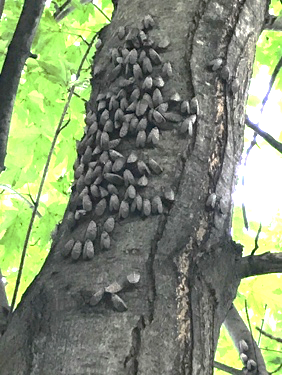
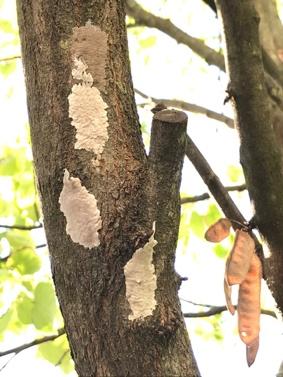
    As beekeepers drive across Pennsylvania and state lines, it is important to understand that SLF can be easily transported on beekeeping equipment. Egg masses (left photo above) can be laid on hive boxes, lids, bottom boards, stands, pallets, etc. Beekeepers must check equipment, vehicles, and trailers for SLF prior to moving the equipment and transporting packages and nucs. If you find SLF individuals of any stage in your apiary or equipment, and you are not inside of the quarantine zone, it is very important that you report it here. To move bees in hives and/or equipment to another state, please contact your Apiary Inspector or State Apiarist (kroccasecc@pa.gov or 717-346-9567). You must be inspected and issued a permit prior to leaving the state whether you are in the quarantine zone or not. 


    In addition to the quarantine policies, lanternflies may impact you and your bees in other ways. Part of the management and efforts to control the spread of this pest include the application of the systemic insecticide dinotefuran to trees infested with SLFs. These insecticide applications may directly or indirectly impact the health of your colonies. Honey bees, wild bees and other pollinators may be directly collecting pollen and nectar from flowers of trees that have been sprayed with insecticides targeting SLF. Indirectly, honey bees may be using the honeydew—the sap that flows when planthoppers feed on plants—as a food source. Research groups at Penn State are investigating the direct and indirect effects of SLF control measures on bee health. For example, two hundred samples of honey were collected last fall from across PA and no traces of dinotefuran were detected. While this is good news, many questions remain open regarding the impact of SLF chemical control on non-targeted insects such as bees. We are still investigating the impacts of these treatments during bloom.  Watch out for more information to come.


    Post contributed by Robyn Underwood, PhD, Assistant Research Professor


    Links to other resources:

  • COMB Update November 2019

    COMB Update November 2019

    The second bee-year of the COMB project was a time of splitting, swarming, and honey production. After winter losses of 62.3% in the chemical free (CF) management system, 13.0% in the conventional (CON) management system, and 14.7% in the organic (ORG) management system, we set out to recover our numbers.

    If a colony had at least 8 frames of brood in the spring, it was split to make a second colony. The split colony was left to requeen itself. Subsequently, if a colony had initiated swarming by making queen cells, the colony was split. Again, the split colony was left to requeen itself. The overwintering losses in CON and ORG colonies were easily made up by splitting. Some CF colonies were able to be split, but there were not enough colonies made to completely make up for losses.

    Despite our best efforts, only 11 PA colonies did not swarm. That means that only about 10% of the colonies made it through the season without a brood break.

    Our management systems
    • Throughout the 2019 season, the colonies were visited every two weeks starting the first week of April. *Each month, alcohol washes were performed on all colonies and summer treatments (see table) were given to colonies in a single “sub-apiary” if one colony exceeded the threshold of 1% infestation in an alcohol wash.  A sub-apiary is defined as the colonies in an apiary that are in the same management system.

    • In late August, fall treatments were applied (see table) and the colonies were generally not disturbed for 6 weeks.
    • Varroa mites were well controlled in CON and ORG colonies. They were much higher, beginning in late summer, in the CF colonies.

    • All of the COMB colonies combined made over 5750 pounds of honey.
    • Management system did not seem to affect the amount of honey made by each individual colony.

    • Going into the winter of 2019-2020, we have 218 colonies; 42 CF, 87 CON, and 89 ORG. We’re hoping for great survival!

    Post contributed by Robyn Underwood, PhD, Assistant Research Professor