Wild lupine is a fire-adapted, perennial wildflower found throughout North America. Due to the loss of its primary habitat, wild lupine is currently of conservation concern in roughly 60% of its range. Lack of disturbance and land management that aims to preserve forests (not open habitats) are contributing factors to its habitat loss. In the midwest, large populations of wild lupine can still be found in oak savanna habitats. In contrast, its populations on the east coast are constrained to early successional edge habitats that are managed for infrastructure like roadsides and powerline rights-of-ways. These human-created habitats are not only refugia for wild lupine but also many other open-habitat associated species of conservation concern.
Habitat comparisons between the natural (A) and human-made (B–C) habitats where Lupinus perennis grows. Habitat depictions include savanna habitat (A), roadside habitat (B), and powerline right-of-way habitat (C). Boxes are not to scale. Created with https://www.biorender.com
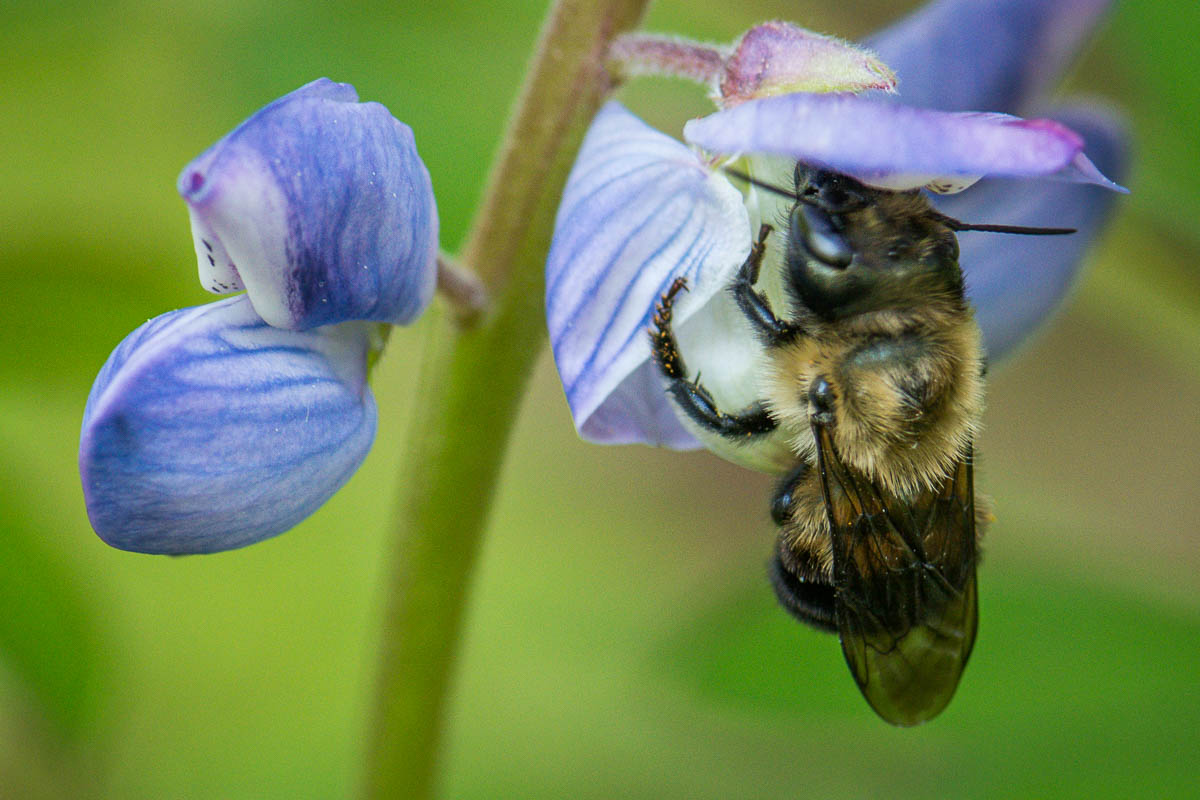
Wild lupine habitat supports several specialist insect herbivores, and many floral visitors and pollinators. Three endangered butterfly species depend on wild lupine for reproduction, including the Karner blue butterfly (Lycaeides melissa samuelis), the Frosted elfin (Callophrys irus), and the Persis dusky wing (Erynais persius). These butterflies feed on wild lupine leaves as caterpillars and depend on this food source to survive. Other insects such as mason bees (Osmia spp.) and bumble bees (Bombus spp.) visit wild lupine for pollen and nectar resources and are the primary pollinators of wild lupine in Pennsylvania.
To aid in the conservation efforts of wild lupine and associated insects, we summarize the existing literature about wild lupine biology and habitat management in our recent paper. Wild lupine prefers open or partially shaded habitat conditions, with a canopy cover of 50% or less, sandy, well-drained soils, and reduced woody vegetation. Previous research suggests that habitat restoration and management can achieve optimal wild lupine habitat with prescribed fire, canopy removal, and herbicide use. Additionally, fences can exclude herbivores like white-tailed deer that consume wild lupine. These management practices do not have substantial negative effects on associated pollinators. Specifically following prescribed fire, studies have shown neutral or positive effects on bee abundance and diversity. Management practices can also be aided through a better understanding of the patterns of genetic diversity in lupine populations (e.g., avoiding inbreeding depression and conserving locally adapted populations). We are currently investigating the effects of prescribed fire and herbivore exclusion fencing on wild lupine fitness and pollinator visitation throughout Pennsylvania. Furthermore, we are assessing the population genetics of wild lupine in varying habitats throughout its range in efforts to conserve wild lupine habitat.
Wild lupine blooms following a prescribed burn applied in the previous dormant season. Photo: Isabella Petitta
You can read more about this research in our paper published in Plant Ecology:
Petitta IR, López-Uribe MM, Sabo AE. Biology and management of wild lupine (Lupinus perennis L.): a case study for conserving rare plants in edge habitat. Plant Ecology.


No responses yet