Tag: Squash Bees

  • Temperature, size, and pathogen load affect wild bee heat tolerance

    Temperature, size, and pathogen load affect wild bee heat tolerance

    Evaluating species’ thermal tolerance is important now more than ever given the ongoing threats to biodiversity under climate change. Species vary widely in heat tolerance, but the degree of variability in their heat tolerance, and the drivers of this variability among populations, are less understood. We expect that some of this variation in bees may be attributed to microclimate, physical differences among individuals, or differences in their infection status. Among “cold-blooded” animals (internal body temperatures are not regulated), larger organisms tend to be more thermally tolerant, and so size likely explains some heat tolerance variation. For individuals in the wild, other factors may impact thermal tolerance, such as infection.


    Bees are cold-blooded animals that pollinate the majority of plants in both natural and agricultural ecosystems. Several bee species are known to be in decline, and stressors such as climate variability and pathogen pressure, among others, are drivers of these declines. However, how these factors impact heat tolerance in bees has not been characterized for wild populations. In this study, we asked, (1) is variation in heat tolerance among populations explained by temperature?, (2) are there size differences among individuals that relate to differences in heat tolerance?, and finally, (3) does pathogen infection reduce heat tolerance?


    We evaluated the heat tolerance of squash bee (Xenoglossa pruinosa) populations across a thermally variant gradient in Pennsylvania, USA. To determine a bee’s heat tolerance, we measured its critical thermal maximum (CTmax), which gives us a proxy for the highest temperature that individuals can withstand. We also weighed the bees and screened them for three common parasite groups – trypanosomes (e.g., Crithidia mellificae), Spiroplasma apis (mollicute bacteria), and Vairimorpha apis (microsporidian, formerly Nosema apis) – to see if body size or pathogen load impacted their heat tolerance.


    We found that temperature did not predict heat tolerance in our squash bee populations. However, we found a strong association between temperature and population-level variation in heat tolerance. Specifically, sites with higher daily temperatures excluded bees with low or high heat tolerance, suggesting that heat stress reduces variation in this trait. Regarding size, we found that larger squash bees were more heat tolerant in congruence with previous studies, but interestingly, males were twice as sensitive to this size effect compared to females! Male squash bees were 40% smaller than females, and so this finding suggests that smaller individuals may be more vulnerable to heat stress. Lastly, we only found that one parasite group, trypanosomes, reduced heat tolerance in highly infected individuals – and again, this effect was sex-dependent! It seems that female squash bees have a harder time tolerating heat when they are hosting a lot of trypanosome parasites in their guts, whereas male heat tolerance isn’t affected by the extra company.


    So, what do our findings mean for understanding variation in heat tolerance among bees and their response to heat stress in the future? First of all, this study provides preliminary evidence that extreme heat can reduce variation in heat tolerance within populations, even if it doesn’t reduce mean heat tolerance at those sites. This is relevant for understanding if populations will be able to buffer themselves against future climate regimes, as it suggests that heat stress is already excluding squash bees with low heat tolerance from sites and reducing heat tolerance for the others that are there. Our results also reveal an important gap in most studies of heat tolerance variation among insects and other taxa – sexes may vary in how size and infection status impact heat tolerance. In our system, we know that the sexes differ physically, behaviorally, and physiologically. For example, female squash bees dig nests underground to lay their eggs, spend their mornings collecting pollen for their young, and go to sleep in their nests by midday. In contrast, the smaller male squash bees do not need to collect pollen for their offspring, and instead look for mates in the morning and then go to sleep in wilted squash flowers. So, the squash bee sexes are expending energy differently (i.e., differences in parental care) and are exposed to different microclimates (i.e., females nest underground). Given the known differences in physical, behavioral, and physiological phenotypes among sexes for many species, the López-Uribe lab will continue to consider sex when evaluating bee thermal tolerance in current and future studies.


    For more details, check out the full article here:

    Jones, L. J., Miller, D. A., Schilder, R. J., López-Uribe, M. M. (2024). Body mass, temperature, and pathogen intensity differentially affect critical thermal maxima and their population-level variation in a solitary bee. Ecology and Evolution, 14(2), e10945


    Contributed post and photography by

    Laura J. Jones

    Postdoctoral Fellow of Plant-Pollinator Ecology

    Department of Integrative Biology at UT Austin


    This study was funded by the USDA-NIFA-AFRI Pollinator Health Program, Project 2022-67013-36274

    Questions? Contact Laura Jones via email at laura.jones@austin.utexas.edu or the López-Uribe lab at lopezuribelab@gmail.com

  • Honey bee viruses are common, but at low levels, in wild bees

    Honey bee viruses are common, but at low levels, in wild bees

    Pathogen transmission from honey bees to wild bees has been attributed as one of the major negative impacts that managed honey bees have on wild bee populations. Among the many pests and pathogens that attack honey bees, the varroa mite and its associated virus, deformed wing virus (DWV), are most abundant and detrimental to honey bee health. The synergistic interactions between this virus and varroa mites have increased the amount of DWV in honey bees and caused what is known as the DWV epidemic. 


    Because flowers are hubs of pathogen transmission among pollinators, the increased viral load of DWV in honey bees has likely facilitated its transmission to other bees and insects that share floral resources with honey bees. Indeed, several studies have reported the presence of DWV in various groups of insects including bumble bees, several groups of solitary bees, syrphid flies, ants, and cockroaches among others. However, studies investigating the transmission of DWV to other insects have focused on the detection (presence or absence) of the virus among pollinators, rather than the level of infection. While DWV infection has been demonstrated in bumble bees, infection in other bees and pollinators has not been shown. Thus, the question remains: are honey bee viruses abundant in wild bee populations? And if so, is the level of infection of honey bee viruses in wild bees related to how many honey bees are present?


    We investigated these questions through surveys of pollinator abundance and honey bee viruses—including DWV—in bee pollinators of pumpkin farms. For two years, we visited 18 pumpkin farms and collected honey bees, bumble bees, and squash bees to quantify the amount of DWV along with four other common honey bee viruses in these bees: 

    We found that DWV was the most common virus among the species sampled, with about 70% of the samples positive for DWV. Specifically, we found that 95% of the honey bees sampled had DWV, compared to 88% of bumble bees and 48% of squash bees. This corroborates with results from previous studies. However, when we quantified the relative levels of DWV in the three species, we found something unexpected! We found an average of 10 million copies of DWV in honey bees, compared to 48 viral copies in bumble bees and 4 viral copies in squash bees. Our results suggest DWV is widespread among these wild pollinators, but the virus does not present at the same level in wild bees as it does in honey bees. Due to the low number of DWV copies we detected in squash bees, we suspect that they are not good hosts for DWV, and that the virus is not infecting them. 

    So, what does this mean and how is this important to our understanding of interactions between honey bees and wild bees? First of all, this study provides empirical evidence that honey bee viruses are likely not having a large negative effect on wild bees. Indeed, experimental studies looking at the fitness costs of DWV infections in other bees have shown that DWV infects bumble bees but not solitary bees. Our results also seem to indicate that solitary bees are likely not severely impacted by the DWV epidemic that is attacking honey bees. This is particularly important given that wild bees often interact with feral honey bee colonies which have uncontrolled levels of varroa mites and experience extremely high DWV infection levels. While we found that wild bees may not be negatively impacted by these honey bee viruses, many wild bees are known to suffer from other pathogens and parasites. Our lab will continue to monitor pathogen and parasite burden in wild bee populations and look for farm management practices that may reduce these threats.


    To learn more about this study, check out our article:

    Jones, L.J., Ford, R.P., Schilder, R.J., López-Uribe, M.M., 2021. Honey bee viruses are highly prevalent but at low intensities in wild pollinators of cucurbit agroecosystems. Journal of Invertebrate Pathology. 185, 107667. 


    Contributed post by

    Margarita López-Uribe, PhD, Assistant Professor of Entomology

    Laura Jones, PhD Candidate in Ecology

    Pennsylvania State University

    Photo credit: Laura Jones
  • A diamond in the pumpkin patch

    A diamond in the pumpkin patch

    I visit pumpkin farms across Pennsylvania to investigate host-pathogen dynamics in bee communities. In pumpkin fields, we typically see three bee species foraging – honey bees, wild bumble bees and wild squash bees. Haven’t heard of squash bees before? These are incredibly important, solitary bees that specialize on the pollen of pumpkin and squash. In fact, they are some of the best pollinators for pumpkin crops in Pennsylvania! Unlike social honey bees and bumble bees where only females bring food back to the hive, both male and female squash bees forage on flowers for nectar, and the females collect pollen for their offspring. Female and male squash bees also behave differently; the females spend much of their time collecting pollen to bring back to their nests, whereas the males frequent many flowers during the morning in search of females and occasionally nectar. Because of these sex-specific behaviors, identifying squash bees by sex is critical to understanding their independent roles in host-pathogen dynamics. However, last year I learned that this isn’t always as simple as it seems.


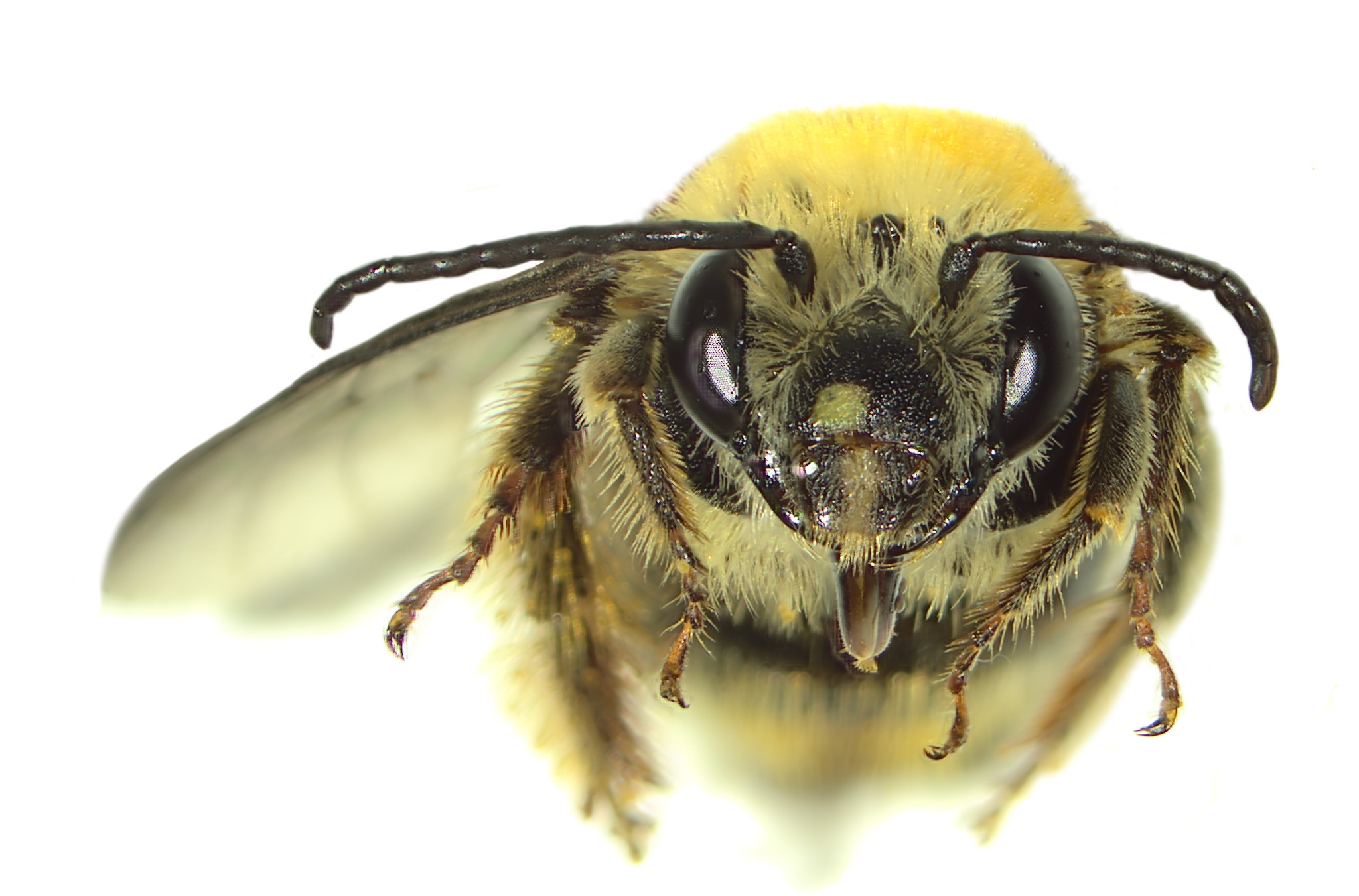
    Squash bees live by the motto, “the early bee gets the nectar,” often starting their day well before sunrise. In order to study them, we have to live by a similar motto, “the early researcher gets the bee.” On one particular day, my labmate Ginamaría Roman-Echevarría and I drove to Butler, PA, starting our journey as usual, at about 3:00AM. In fact, everything about the start to our day was as it usually was: we drank too much coffee, sang along to our field work playlist, and then collected bees in the all-too-cold morning weather. When collecting squash bees, we try to confirm their sex from a few key characters. The males have long antennae and a yellow spot on their face. The females have bushy hind legs covered in long setae that they use to transport pollen back to their nests. When in the flower, we identify these busy mothers the fastest since their legs look enlarged and bright yellow from the pollen they’ve collected. I remember finding one such female, though strangely, only one leg looked full of pollen. I noticed she was indeed collecting pollen, even if only successfully on one leg, so I scooped her up and labeled her as female. When we were satisfied with the day’s haul we drove back to the lab. The hard part was over, or so we thought.


    At the lab, I first confirm our field identifications before determining pathogen loads. When going through the bees to confirm their identifications this particular day, I noticed something strange. One female-labeled bee, the inefficient pollen-collector, had a long antennae. Then I noticed, she had a yellow spot on one side of her face. Lastly, I realized I had unfairly judged her pollen-packing abilities in the field – her left leg didn’t have the long setae it needed to hold pollen! What I was looking at, ladies and gentleman, was a half-lady, half-gentleman. Her head was split as left-female, right-male, yet her body was split right-female, left-male. We had found a mosaic gynandromorph, where male and female characters are patchily distributed throughout the body. These bees are very rare to find in the field and the mechanisms that lead to their development are not well known. In other organisms, gynanders can develop due to external stressors such as pollution, or even parasitism! We may never know what caused this particular bee to develop into a gynandromorph. However, we hope that with more documentation of these individuals in wild systems, we may be able to capture the frequency of their occurrence, and potentially identify what stressors may result in their development.


    To learn more about this particular specimen or the potential developmental and environmental mechanisms of gynandromorphism in insects, check out our article in the Journal of Melittology.


    Photo credit: Laura Jones and Shelby Kilpatrick

    Contributed post by

    Laura Jones, PhD Candidate

    Intercollege Graduate Degree Program in Ecology

    Pennsylvania State University