Category: News feed

  • Our first feral sample of the season

    Our first feral sample of the season

    The Tracking of Feral Bees project at Penn State is underway. Last Thursday night, we set out on our first feral bee adventure of the year! About 45 minutes south of State College, in Huntingdon County PA, we sampled individuals from the our feral colony of our study. A great sycamore tree, close to 100 years old, had fallen. The tree had a large cavity that was home to a feral colony. The comb inside the colony was brown and aromatic, indicating the that the colony has resided for several years. We gathered our gear, including a smoker and fuel, veil, tubes for collecting samples, dry ice, and a phone for navigation, and headed out. The task appeared trickier than we had initially thought. The bees were rambunctious earlier in the day after the tree had fallen, but as the sun went down the bees huddled together and were determined to not break their winter cluster! We could hear them buzzing as we waited outside the entrance to the colony. We had sampling tubes in hand, ready to capture each bee as they left the colony. It took about 30 minutes to collect 30 bees, and after 7pm we excitedly returned to State College. The samples were stored in -80 for future genetic analyses. The tree will be removed next week and we shall return in an attempt to save the colony.

    Written by Katy Evans, Field Technician in the López-Uribe Lab.

    Feral colony inside the cavity of a fallen tree (January 19, 2017)

    Contributed by Katy Ciola Evans 

  • PSU Apicultural Survey Results 2016

    PSU Apicultural Survey Results 2016

    [av_textblock size=” font_color=” color=”]
    It was a wonderful weekend at the Pennsylvania State Beekeepers Association conference in State College. Beekeepers came from all over PA to listen and learn about honey bees and beekeeping. I am Margarita, a new assistant professor at Penn State and leader of the Lopez-Uribe Lab. I was a guest speaker at the PSBA conference and gave a quick overview of my research and the future goals of my lab. I handed out a survey during the conference in hopes of finding out more details about PA beekeeper demographics and their interests. In total, 29 beekeepers took the survey. Here is a link that includes a short summary of the results. 

    https://docs.google.com/document/d/1WMUUVt1UCKzoIMdIS6jCXNdxKqmDQgk7rL51-BH4DSI/edit

    [/av_textblock]

  • BEEKEEPING SALE at Wiley Lab/PSU

    BEEKEEPING SALE at Wiley Lab/PSU

    If you need it, we will have it! Buzz on over to the Wiley Bee Lab at Penn State, State College PA this Saturday November 12 from 3-6pm

    We are selling beekeeping equipment at a discount

    Inventory: Shallow, medium and deep hive bodies with frames and plastic foundation, tops, migratory lids, inner covers, bottom boards, screen bottom boards, plastic pollen trap, plastic frames, plastic foundation, feeders

    We accept ONLY cash or checks

    Address: Wiley Ln State College, PA 16803

  • Methods of oxalic acid (OA) treatments

    Methods of oxalic acid (OA) treatments

    Methods of oxalic acid (OA) treatments

    We have begun our first project in the Lopez-Uribe Lab (@lopezuribelab). Our aim is to compare the effectiveness of two methods of oxalic acid (OA) treatments for mite control: the trickle method (trickling of OA sugar syrups into honey bee colonies) and vaporizer method (OA fumigation through vaporization).

    Background: Oxalic acid (OA) has been adopted by many beekeepers worldwide as a valuable tool for Varroa control. OA toxicity to Varroa has been known for several decades based upon research in Asia, Europe and Canada and in late 2015 it was approved in the U.S for use in honeybee hives. The two most common methods used to apply OA to bees are the trickle or liquid solution and the vaporizer. It is best to treat when there is little or no brood present in the colony, typically fall/winter, which also provides beekeepers with an excellent “cleanup” tool for colonies with residual varroa populations that rebound in late summer. Mite mortality is the result of contact with OA and only effects phoretic mites. Research has also suggested that cooler temperatures are better to treat because there may be a correlation with increased mortality when applied during periods of high humidity.

    Our experiment began October 31st. The high temperature was 55°F, just cool enough for the bees to remain clustered inside the hive. We took a mite count via sticky boards two days prior (October 29st) and two post (November 4th) treatment. For the trickle method, we prepared fresh OA solution by dissolving 35 g of OA dihydrate in 1 liter of one to one warm sugar solution prior to treatment. The amount of OA applied to each colony was dependent on size of the colony. A 50 ml syringe was used to trickle the oxalic acid sugar solution directly onto the bees that are clustered between the frames (occupied bee space) in each hive body. The maximum recommended dose for one colony is 50 mL, with an average of 5mL per bee frame . We used between 35 and 45mL for most of our colonies.

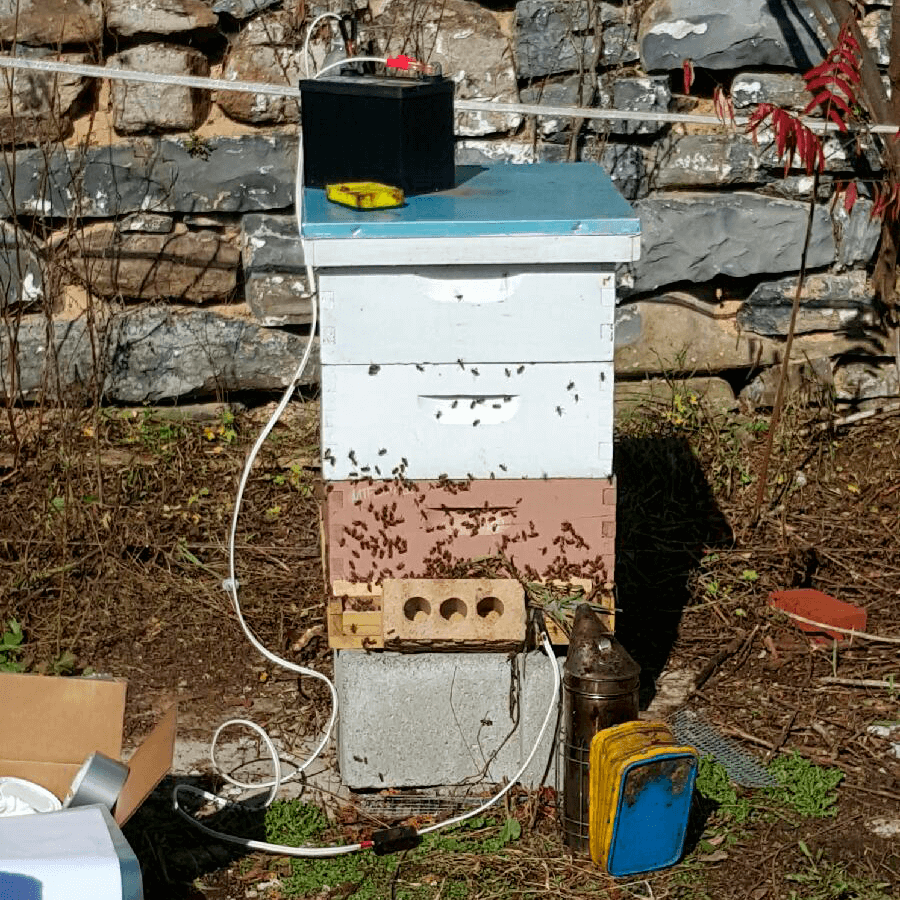
    For the vaporizer method, we followed the instructions that come with a vaporizer. Note that these instructions will vary with each vaporizer. We treated each colony with 2g OA dehydrate that was sublimated with a JB4 vaporizer. We placed the vaporizer in the hive entrance and blocked it with a wet cloth. It took about 2 minutes for the OA to fully vaporize once it was inside the colony. We removed the vaporizer and closed up all entrances for 10 minutes, including blocking the entrance with a cloth and placing a plastic plate under the screen bottom boards. Previous studies have reported high efficacy for both methods however, the risk to the applicator is greater during vaporization due to the potential of inhalation of the OA fumes. Be safe and stay tuned for the results of our experiment.

    Written by Katy Evans, Field Technician in the López-Uribe Lab.